A current  flows along a thin wire, shaped as a regular polygon with
  sides, which can be inscribed intro a circle of radius
  . Find the magnetic field at the center of the polygon. What happens if is made very large?
Solution:
The polygon described in the problem is illustrated in the figure below, for  . The magnetic field created by this structure is the superposition of fields from straight current carrying wires of length
  . Therefore, we will need to find the magnetic field due to a wire of finite length first.

The Biot-Savart law gives the magnetic field contribution from a small circuit element  carrying current , at a point
  away from it:
(1) 
To find the field generated by a straight wire, we break it up into small segments  as shown in the figure. We are interested in the field at a point
  away from the middle of the wire. Using the right hand rule,
(2) 
which points into the plane of the paper. Therefore, the field due to the differential element is
(3) 
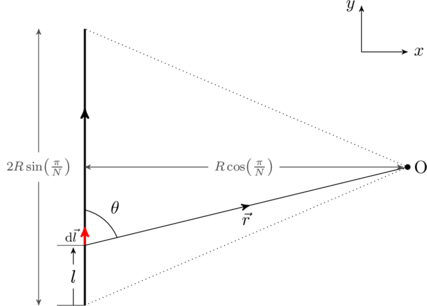
We can also find the following relationship between different lengths from the above figure,
(4) 
Differentiating this leads us to a relationship between  and
and  ,
,
(5) 
where we have used  in the last step (another way of deriving the above relation is discussed at the end). Plugging this into (3),
(6) 
Integrating this expression gives the magnetic field due to a single side of the polygon at its center,
(7) 
The total field at the center is
(8) 
In the limit of large , the angle  becomes very small and we can approximate
  (see figure). Then,
(9) 
which is the field generated by a ring of current of radius , at its center.

Note: We could also have related the differential length to with geometry (see figure),
(10) 
Substituting  leads us to (5).

Bonus problem
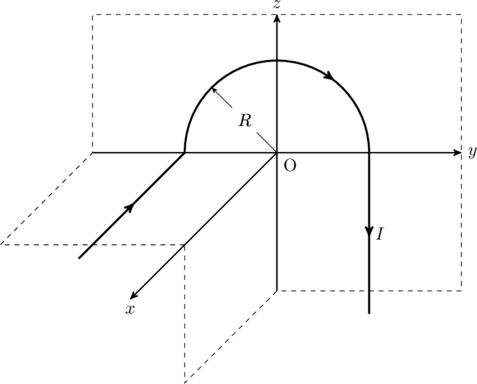
Find the magnetic field at point O in the figure below.